Tim Fairchild


·
China exported 3.43 million electric vehicles last year — a 70% increase on 2024. In the first two months of 2026 alone, 583,000 new energy vehicles left Chinese ports, a 110% year-on-year surge. These vehicles are arriving at European terminals, North American ports, and processing compounds in volumes that the finished vehicle logistics industry has never handled before — and many of them are brands that local operators are seeing for the first time.
This is not just a volume story. It is a quality management story. Every one of those vehicles needs to be inspected, documented, stored, and delivered with a level of condition accountability that legacy paper processes were never designed to handle — particularly when the vehicles themselves introduce handling requirements that differ fundamentally from conventional ICE fleets.
The numbers tell part of the story. ECG’s latest business intelligence data shows 1.35 million vehicles exported from China in the first two months of 2026, with passenger car NEVs accounting for 98% of the new energy vehicle volume. Belgium — specifically the port of Zeebrugge — remains the primary transit point for Chinese EVs entering the European market, with vehicles distributed onwards to Germany, France, Italy, and Switzerland.
In early 2025, ECG reported nearly 80,000 unsold Chinese electric cars sitting in European ports. That stockpile represents a compound management challenge as much as a commercial one: vehicles in long-term storage require charge monitoring, condition documentation, and handover records that accumulate complexity with every week they remain on site.
For terminal operators and compound managers, these aren’t just more cars. They’re more cars from more brands, with different handling specifications, different damage profiles, and different OEM requirements — arriving faster than operational playbooks can be updated.
Electric vehicles introduce quality management variables that don’t exist with conventional fleets. Understanding these differences is not optional for operators handling EV volumes at scale.
Battery condition is invisible and critical. The most consequential damage on an EV may not be visible. Undercarriage impacts that would cause cosmetic concern on an ICE vehicle can compromise battery housing integrity on an EV, creating thermal runaway risk. Inspection protocols need to capture undercarriage condition systematically — not as an afterthought, but as a mandatory documentation step at every handover.
State of charge management is an operational requirement. EVs in transit and storage need to maintain battery levels within safe ranges — typically between 20% and 50%. Vehicles that arrive over-charged or under-charged require intervention. Documenting state of charge at each handover point creates the evidence trail that both insurers and OEMs increasingly require. This needs to be a structured data field, not a free-text note buried in a general inspection form.
Damage categorisation needs EV-specific codes. Conventional vehicle damage codes were designed for dents, scratches, and glass. EVs add charging port damage, battery housing compromise, thermal management system issues, and high-voltage component concerns. AIAG’s M-26 Battery Electric Vehicle Supply Chain Handling Guideline — developed with Honda, Ford, GM, Nissan, Stellantis, Toyota, and Volkswagen — addresses these categories, but many operators are still running inspection templates designed for ICE-only fleets.
Storage compounds become active management environments. An ICE vehicle can sit in a compound for weeks with minimal attention. An EV in long-term storage requires periodic charge monitoring, protection from temperature extremes, and documented condition checks. When 80,000 unsold EVs are sitting in European ports, the compound operator bears responsibility for condition at the point of eventual release — and that requires a documentation trail that extends across the entire storage period.
European and North American logistics operators have decades of experience handling vehicles from established OEMs. They know the damage reporting requirements for BMW, the inspection standards for Toyota, the delivery specifications for Volkswagen. These processes are deeply embedded in operational muscle memory.
Chinese EV exports are changing the equation. BYD, NIO, Geely, XPeng, MG, and dozens of smaller brands are arriving at ports with their own specifications, their own quality expectations, and — in many cases — limited local logistics infrastructure. Operators are handling vehicles from brands they may not have encountered six months ago, with inspection requirements that differ from anything in their current template library.
This brand proliferation creates two quality management problems. First, the inspection process needs to be flexible enough to accommodate different OEM requirements without slowing down. Configurable inspection templates with custom fields — rather than fixed forms — become essential when the brand mix changes quarterly. Second, the damage reporting needs to produce records that are intelligible to OEM quality teams who may be operating from different standards frameworks. Alignment with globally recognised coding systems like the AIAG-ECG M-22 damage codes provides a common language.
The good news is that the industry’s standards bodies are not standing still. ECG’s Quality Working Group has made EV handling — particularly in maritime environments — an explicit ongoing focus. Their January 2025 joint meeting with the Maritime & Ports Working Group in Zeebrugge addressed BEV transport, fire risk on vessels, and containerised vehicle movements directly.
AIAG has published both the M-26 BEV Supply Chain Handling Guideline and an updated M-22 damage codes standard (now in its 6th edition) that provides the global framework for consistent damage reporting. The European Maritime Safety Agency (EMSA) has issued dedicated guidelines for alternative fuel vehicles that ECG actively promotes across its membership.
The EU Battery Passport regulation, which becomes mandatory for imports in 2026, adds another layer of traceability requirement. Operators will need digital systems capable of linking inspection records to battery-level identifiers — a level of granularity that paper processes simply cannot deliver.
Collectively, these standards responses share a common thread: they all assume digital data capture as the baseline. Structured fields, timestamped records, GPS-tagged evidence, and VIN-level traceability are not aspirational features in this context. They are the minimum operational requirement.
The EV quality management challenge is not a future problem. It is a current operational reality for any terminal operator, compound manager, or logistics provider handling EV volumes today. Three practical steps will close the gap:
Update your inspection templates for EV-specific fields. State of charge, battery housing condition, charging port status, and high-voltage component integrity need structured data fields — not optional notes. If your inspection app doesn’t support configurable custom fields, it wasn’t designed for the fleet mix you’re handling now.
Build charge monitoring into your compound management workflow. Any EV in storage for more than 48 hours should have documented charge status. Weekly condition checks should be the minimum for vehicles in extended storage. The record this produces is the evidence your insurer will ask for if a battery event occurs.
Ensure your damage reporting aligns with AIAG-ECG standards. When Chinese OEM quality teams, European insurers, and North American regulators all need to understand the same damage event, a standardised coding system is the only thing that prevents misinterpretation. The M-22 damage codes exist for exactly this reason.
There is a tension in this conversation that operators feel acutely: more thorough inspection requirements versus the pressure to maintain throughput. When berth windows are fixed and shift patterns are set, adding EV-specific documentation steps looks like adding time.
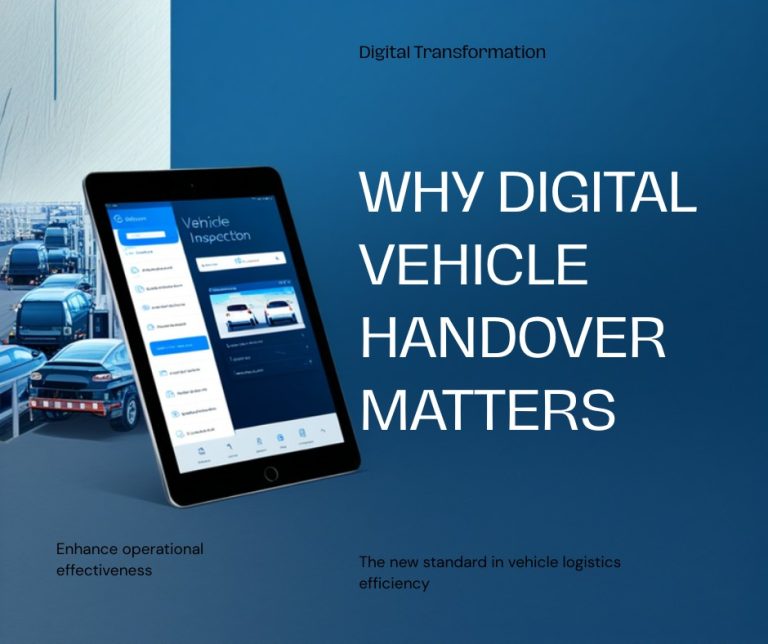
This is where tool selection matters. Purpose-built mobile inspection platforms with Express Mode for high-volume environments, barcode and VIN scanning that eliminates manual entry, and Job Cloning that replicates job structures instantly — these aren’t nice-to-have features. They’re the operational response to a documentation standard that is getting more demanding at exactly the moment when volumes are getting larger.
The operators who will navigate the EV quality challenge most successfully are those who treat it not as an additional compliance burden, but as a data infrastructure investment. Every structured inspection record, every timestamped handover, every VIN-level condition report is both a compliance asset and an operational one. The same data that defends a claim also identifies damage patterns, informs OEM reporting, and drives continuous improvement.
The EV tide is not receding. The quality management challenge it brings is the new baseline. The question for every operator is whether their inspection and documentation infrastructure is ready for the fleet that’s already on the water.
Bison Grid’s quality management and ePOD platform is purpose-built for finished vehicle logistics — with configurable inspection templates, multi-language support across 8 languages, and offline capability for port environments. Over 1 million vehicles inspected across 4 continents. Get in touch to discuss how operators are adapting their inspection workflows for growing EV volumes.